
Last Updated on: October 29, 2026
A reliable timing machine helps watchmakers measure daily rate, beat error, amplitude, and beat frequency when diagnosing or regulating mechanical watches. The right tester can make adjustments more consistent while reducing guesswork at the bench.
We compare 10 watch timing machines for watchmakers, covering multifunction timegraphers, LCD-equipped models, acoustic pickup tools, and practical options for different workshop needs and budgets.
Best 10 Watch Timing Machines for Watchmakers Picks for 2026
Precision Bench Pick
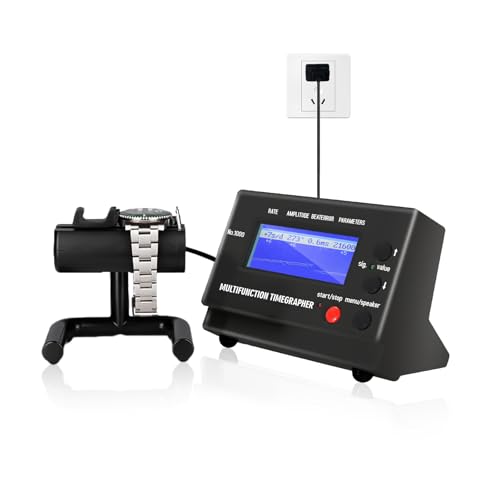
- Stated ±0.1 s/d accuracy with averaging
- Shows rate, amplitude, beat error, and curves
- Six positions and adjustable lift angle
Best For: Professional mechanical-watch diagnostics
Collector-Friendly Choice
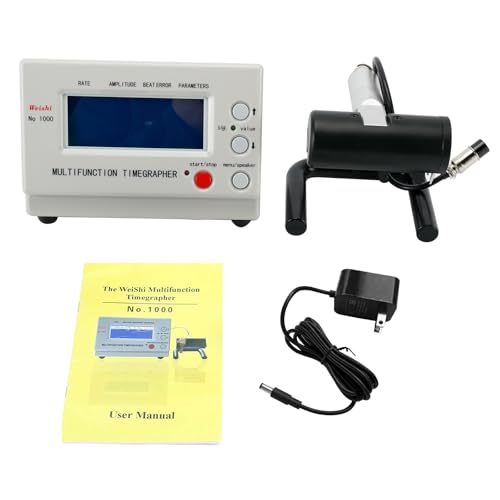
- Automatically calculates three key readings
- Six testing positions
- Selectable 2–60-second sampling periods
Best For: Collectors and straightforward mechanical-watch testing
Compact Professional Option
NO.1000 Multifunction Timegrapher

- Tests almost all mechanical watches
- Compact corded design
- Listed for professional and collection use
Best For: General bench testing where space is limited
Portable Measurement Pick
Pongnas Multifunction Timegrapher

- Real-time rate, amplitude, and beat-error display
- 0.1 ms beat-error resolution
- 100°–360° swing measurement range
Best For: Portable digital checks on mechanical watches
Best High-Resolution Pick

- Color screen with dual trace display
- Measures rate, amplitude, and beat error
- Supports one to six measuring positions
Best For: Watchmakers needing clearer diagnostic traces
Best Lightweight Touch-Button Option
MTG-8000 Mechanical Watch Tester

- Touch-button operation
- Coaxial testing method
- Thin and light design
Best For: Mechanical-watch users wanting simple controls
Best Straightforward Bench Tester

- Large high-resolution LCD screen
- Shows five live timing measurements
- Includes sensor, adapter, and manual
Best For: Mechanical-watch calibration and routine checks
USB-Ready Calibration Pick
Multifunction Watch Timegrapher

- Measures rate, amplitude, beat error, frequency, and waveform
- USB/RS232 data transfer for compatible computers and tablets
- Adjustable sliding jaws fit various dial sizes
Best For: Connected workbenches needing versatile mechanical-watch analysis
Beginner-Friendly Essentials

- Measures rate, amplitude, and beat error
- Shows results numerically and graphically
- Includes sensor, US adapter, manual, and cleaning cloth
Best For: Beginners learning mechanical-watch accuracy analysis
Precision Portable Tester
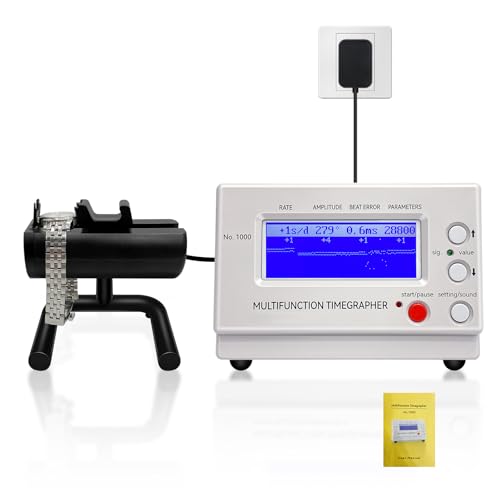
- Tests rate, amplitude, polarity, beat, lift angle, and period
- Provides 0.1 s/d resolution across a ±999 s/d range
- Portable design with 100V–240V ±10% input
Best For: Technicians needing detailed, portable mechanical-watch diagnostics
Precision Bench Pick – SWANSOFT No.1000 Timegrapher
For watchmakers seeking watch timing machines for watchmakers with detailed diagnostics, the SWANSOFT No.1000 combines high stated accuracy with a color display and broad adjustment options. It is designed for mechanical movements only, not quartz watches.
Best For: Professional benches, advanced movement diagnosis, and users who need live rate, amplitude, beat-error, and timing-curve data.
Pros:
- Stated accuracy of ±0.1 seconds per day with a 50-sample average.
- Displays rate, amplitude, beat error, lift angle, and timing curves in real time.
- Supports six positions, 2–60-second sampling cycles, and adjustable 30°–70° lift angles.
- Includes a sensor, US adapter, manual, and 12-month support.
Cons:
- Only suitable for mechanical movements.
- Its professional feature set may be more than casual collectors need.
The No.1000 is the most feature-rich option in this roundup, particularly for users who want broad measurement ranges and visual diagnostics at the workbench.
Collector-Friendly Choice – YaeTek No.1000 Watch Tester
The YaeTek No.1000 is a practical choice among watch timing machines for watchmakers and collectors who want automatic calculations on a dedicated LCD screen. It tests mechanical watches and includes selectable sampling periods for evaluating readings over time.
Best For: Mechanical-watch collectors and repair users who want straightforward rate, amplitude, and beat-error measurements with six position settings.
Pros:
- Automatically calculates rate, amplitude, and beat error.
- Offers six adjustable testing positions.
- Sampling periods range from 2 to 60 seconds, with averaged readings.
- Uses an LCD screen with moving dotted lines to visualize the ticking signal.
Cons:
- The supplied notes specify a 110V–220V US plug, so buyers should confirm compatibility.
- It is intended for mechanical watches rather than quartz testing.
With automatic signal adjustment and a range of sampling choices, this YaeTek model suits users who value simple operation and readable real-time results.
Compact Professional Option – NO.1000 Multifunction Timegrapher
This compact NO.1000 is a focused option for buyers comparing watch timing machines for watchmakers. It is corded, designed for mechanical watches, and intended to measure beats per unit time across a broad range of compatible movements.
Best For: Watchmakers and collectors who want a compact, corded timegrapher for general mechanical-watch testing.
Pros:
- Designed to test almost all mechanical watches.
- Multifunction format is suited to professional watchmaking and collection use.
- Compact dimensions of 6.77 × 1.57 × 4.49 inches.
- CE specification is listed.
Cons:
- The supplied notes provide fewer display and measurement details than some competing models.
- Requires corded electric power and a minimum operating voltage of 100 volts.
This model makes sense when footprint and broad mechanical-watch compatibility matter more than an extensive list of advanced controls.
Portable Measurement Pick – Pongnas Multifunction Timegrapher
The Pongnas tester is a portable option for shoppers evaluating watch timing machines for watchmakers. It provides real-time rate, amplitude, beat-error, polarization, and frequency information on an LCD screen for mechanical-watch testing.
Best For: Users who want a portable instrument with clear digital measurements for daily difference, beat error, and swing.
Pros:
- Displays rate, amplitude, beat error, and frequency diagrams in real time.
- Measures beat error from 0 to 9.9 milliseconds with 0.1-millisecond resolution.
- Measures swing from 100° to 360° with 1° resolution.
- Portable design is described as easy to install and operate.
Cons:
- The supplied product dimensions appear unusually small, so buyers should verify the physical size before ordering.
- The notes do not specify testing positions or power details.
Its broad digital readout and portability make the Pongnas appealing for users who prioritize quick, accessible measurements over a more extensively documented feature set.
Best High-Resolution Pick – TICFROG No.1900 Timegrapher
For watch timing machines for watchmakers, the TICFROG No.1900 stands out with a larger color display and dual trace visualization. It measures rate deviation, amplitude, beat error, beat number, and lift angle, making it useful for routine checks and mechanical-watch troubleshooting.
Best For: Watchmakers, collectors, and hobbyists who want clearer readings and entrance-versus-exit trace visibility.
Pros:
- High-resolution color screen shows two traces in contrasting colors.
- Measures rate deviation, amplitude, and beat error while displaying beat number and lift angle.
- Supports one to six measuring positions and mechanical and coaxial watches.
- Includes a sensor, US adapter, manual, and cleaning cloth.
Cons:
- Designed for mechanical watches rather than quartz watches.
- Its broader troubleshooting features may be more than casual users need.
The dual-trace display is the key advantage here, especially when adjusting beat error or diagnosing faults. It is a practical choice for a watchmaking bench that needs more visual information than a basic timegrapher.
Best Lightweight Touch-Button Option – MTG-8000 Mechanical Watch Tester
Mechanical Watch Tester Timing Multifunction Timegrapher MTG-8000 touch button
Check Price On AmazonIf you are comparing watch timing machines for watchmakers, the MTG-8000 offers a streamlined design with touch-button controls. Its coaxial testing method is intended to work with essentially all mechanical watches, making it a versatile option for a repair or testing bench.
Best For: Users who prefer a thinner, lighter timegrapher with touch-button operation for mechanical-watch testing.
Pros:
- Uses a coaxial test method applicable to mechanical watches.
- Touch-button controls provide a simple operating interface.
- Thinner and lighter appearance than many traditional bench testers.
- Designed as a multifunction timing instrument.
Cons:
- The supplied notes do not specify its measurement ranges or display resolution.
- Its stated testing scope is mechanical watches, with no quartz support indicated.
The MTG-8000 is worth considering when ease of handling and broad mechanical-watch compatibility matter more than detailed published specifications. Confirm the included features and measurements if you need highly specific diagnostic data.
Best Straightforward Bench Tester – SWANSOFT No.1900 Timegrapher
The SWANSOFT No.1900 is a practical choice among watch timing machines for watchmakers, with a larger high-resolution LCD screen and backlit interface. It displays rate, amplitude, beat error, beat, and lift angle live for mechanical-watch performance checks.
Best For: Hobbyists, collectors, technicians, and watchmakers seeking an easy-to-read mechanical-watch calibration tool.
Pros:
- Larger, high-resolution color LCD screen improves readability.
- Displays rate, amplitude, beat error, beat, and lift angle live.
- Easy-to-operate backlit interface suits bench testing.
- Includes the timegrapher, sensor, US adapter, and professional manual.
Cons:
- Only suitable for mechanical movement watches and does not support quartz.
- The housing and crystal are listed as plastic.
This model balances essential timing measurements with a readable screen and uncomplicated operation. It is a sensible fit for users who want a dedicated mechanical-watch tester without needing the more specialized trace comparison described for the TICFROG model.
USB-Ready Calibration Pick – Multifunction Watch Timegrapher
For watchmakers comparing watch timing machines for watchmakers, this multifunction timegrapher stands out for its broad measurement set and computer data-transfer support. It measures daily rate, amplitude, beat error, frequency, polarization, oscillation, and waveform, while adjustable sliding jaws help hold different dial sizes.
Best For: Workbenches that need flexible mechanical-watch analysis and convenient PC, tablet, or laptop data handling.
Pros:
- Supports multiple measurements, including daily rate, amplitude, beat error, frequency, and waveform.
- USB/RS232 connectivity supports data transfer to compatible computers and tablets.
- Removable, adjustable jaws accommodate various watch dial sizes.
- Compact 3.94-by-2.36-by-1.97-inch design with a low 3.99-ounce weight.
Cons:
- The supplied notes do not specify measurement ranges or display resolution.
- Computer connectivity may require compatible hardware or setup.
This is a practical choice when data transfer and measurement versatility matter as much as basic rate checking. Its adjustable holder also makes it more adaptable than a fixed-position tester.
Beginner-Friendly Essentials – TICFROG No.1000 Timegrapher
The TICFROG No.1000 is a straightforward option among watch timing machines for watchmakers, covering the core readings needed to evaluate mechanical-watch accuracy. Its sensor detects escapement sounds or vibrations and displays beat rate, beat error, and amplitude both numerically and graphically.
Best For: Beginners and hobbyist watchmakers who want essential timing information without an overly complex feature set.
Pros:
- Measures rate, amplitude, and beat error for basic accuracy diagnosis.
- Displays readings graphically and numerically.
- Automatic signal-level adjustment supports simpler operation.
- Includes the timegrapher, sensor, US adapter, manual, and cleaning cloth.
Cons:
- It is designed around essential functions rather than the broader analysis features of advanced models.
- The included adapter is specified as US type.
- It is not water resistant.
With its essential measurements, automatic signal adjustment, and included accessories, the No.1000 is positioned as an accessible starting point for learning how to interpret mechanical-watch timing behavior.
Precision Portable Tester – High-Range Watch Timegrapher
This compact timegrapher is a strong contender for watch timing machines for watchmakers who want detailed measurements in a portable format. It tests daily rate, beat amplitude, polarity, beat, lift angle, and period, with acoustic sensing, adjustable sampling, and support for multiple measurement directions.
Best For: Technicians and experienced enthusiasts who need broader diagnostic controls and precise rate readings on a space-conscious workbench.
Pros:
- Measures daily rate, amplitude, polarity, beat, lift angle, and period.
- Offers a ±999 seconds-per-day range with 0.1 seconds-per-day resolution.
- Supports 2–60-second sampling periods and 1–6 directional measurements.
- Compact ABS body, color LCD, and 100V–240V ±10% input support portability.
Cons:
- The broader controls may require more familiarity than a basic timegrapher.
- The display resolution is listed as 192×64 pixels.
- It is not water resistant.
Its combination of fine rate resolution, multiple diagnostic metrics, and wide-voltage portability makes it suitable for more demanding calibration work. The included instructions are intended to simplify operation, but the expanded settings still reward careful setup.
How We Picked the Best Watch Timing Machines for Watchmakers
We focused on the measurements that matter during mechanical-watch testing: daily rate, amplitude, beat error, beat frequency, and the ability to evaluate multiple positions. We also considered display readability, microphone or pickup design, operating simplicity, calibration features, and the practical needs of a repair bench.
Because product listings can vary by seller, confirm the supplied accessories, supported beat frequencies, power requirements, and return policy before ordering. A low-cost timegrapher can be useful for screening and regulation, but it should not be treated as a substitute for complete service equipment or a certified reference instrument.
Quick Comparison
| Best For | What to Look For |
|---|---|
| Routine regulation | Clear rate, amplitude, beat error, and beat-frequency readings |
| Busy repair benches | Fast controls, stable pickup, and easy-to-read display |
| Learning and occasional use | Simple operation, broad compatibility, and lower cost |
| Position testing | Reliable signal capture and easy switching between positions |
Key Buying Factors for Watch Timing Machines
Measurements and Accuracy
Prioritize a machine that clearly reports daily rate, beat error, amplitude, and beat frequency. Accuracy depends on signal quality, watch condition, lift angle settings, and calibration, so look for adjustable parameters and consistent readings rather than relying only on advertised precision.
Pickup and Compatibility
An acoustic pickup or microphone must hold the watch securely and capture a clean escapement signal. Check whether the design accommodates different case sizes and whether it works well with the movements you service. Adjustable beat-frequency support is especially useful when working across multiple brands and movement families.
Display and Workflow
A bright LCD or clearly arranged interface makes it easier to monitor readings while turning a regulator. Position modes, memory or trace functions, touch controls, and automatic beat detection can save time, but simple controls may be preferable if you value dependable bench operation over extra features.
Build Quality and Support
Look for a stable base, durable buttons, a secure watch rest, and an included power adapter that matches your region. A seller with replacement accessories, documentation, and a practical warranty is worth considering, particularly for professional use.
Who Should Buy Which Watch Timing Machines for Watchmakers?
Professional watchmakers: Choose a well-built multifunction timegrapher with dependable pickup performance, readable measurements, and broad beat-frequency support.
Students and hobbyists: A straightforward No.1000-style tester can provide the essential readings needed to learn regulation without paying for advanced workshop features.
Mobile technicians: Favor compact units with simple controls and a secure platform that can be transported without losing calibration or damaging the pickup.
Collectors and occasional users: Choose the clearest, easiest-to-use model that reports the core measurements. Before buying, verify that it supports your watches and includes every cable, pickup, and accessory shown in the listing.