
Last Updated on: October 29, 2026
A reliable timegrapher can reveal whether a mechanical watch is running fast, slow, or inconsistently before you attempt regulation or servicing. The best affordable models display core measurements such as daily rate, amplitude, and beat error in a format that is easy to interpret.
This roundup compares 10 watch-testing and repair tools priced around the under-$200 range, including dedicated timegraphers, multifunction testers, demagnetizers, and related workshop equipment. Use the guide below to match the machine’s features and limitations to your collection, repair bench, or hobbyist needs.
Best 10 Watch Timing Machine Under 200 Picks for 2026
Best Overall
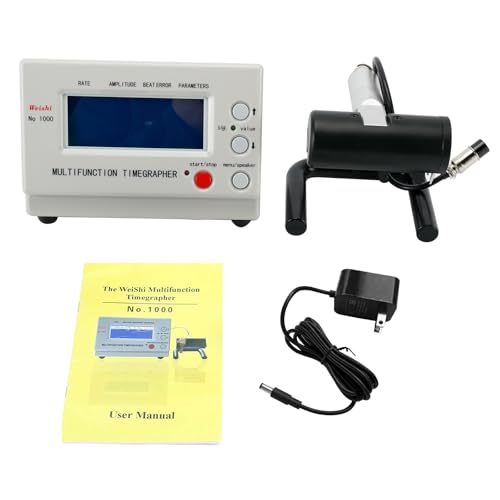
- Automatically measures rate, amplitude, and beat error
- Six positions with 2–60-second sampling
- LCD display with visual tic-tock waveform
Best For: Mechanical watch collectors and hobbyists
Best for Computer Data

- Transfers data to compatible computers and tablets
- Adjustable clips hold various watch sizes
- Displays signal, frequency, and waveform information
Best For: Connected watch-testing workflows
Best Multifunction Tool
Quartz and Battery Watch Tester

- Combines quartz, battery, pulse, and demagnetizer functions
- Adjustable demagnetization speed
- Compact and battery powered
Best For: Portable watch repair and battery checks
Best for Easy Setup
Howkun WEISHI No.1000 Timegrapher

- Real-time rate, amplitude, and beat-error readings
- Six testing positions with adjustable sampling periods
- Includes microphone, adapter, and English manual
Best For: Repairers and hobbyists needing flexible watch testing
Best Hand-Setting Tool

- Four interchangeable steel needle tips
- Includes three movement bases
- Designed for controlled hand installation
Best For: Hand replacement and installation work
Best Simplified Timegrapher

- Real-time rate, amplitude, and beat-error calculations
- Selectable 2-to-60-second sampling periods
- LCD frequency diagram and automatic signal adjustment
Best For: Hobbyists seeking straightforward mechanical-watch testing
Waterproof Testing Specialist
Dual-Watch Underwater Pressure Tester

- Tests two watches simultaneously
- Fits many mechanical and quartz watches
- Compact manual glass-and-aluminum construction
Best For: Checking watch case water resistance
Data-Ready Calibrator
Multifunction Mechanical Watch Timegrapher

- Measures rate, amplitude, and beat error
- Includes adjustable sliding jaws
- Transfers data via USB/RS232
Best For: Mechanical watch calibration and analysis
Compact Sound-Based Tester

- Sensitive vibration sensor captures watch sounds
- Noise-reduction cavity supports clearer testing
- Battery-powered and lightweight
Best For: Basic mechanical watch vibration testing
Best Overall – YaeTek NO.1000 Timegrapher
The YaeTek NO.1000 is a practical watch timing machine under 200 for mechanical-watch owners who want clear, real-time readings without a complicated setup. It automatically calculates rate, amplitude, and beat error through its microphone stand, while the LCD shows both numerical results and a visual tic-tock waveform.
Best For: Mechanical watch collectors and hobbyists who want adjustable testing positions and selectable sampling periods.
Pros:
- Measures rate, amplitude, and beat error automatically.
- LCD screen provides real-time readings and moving visual lines.
- Offers six testing positions and sampling periods from 2 to 60 seconds.
- Supports 110V-220V power with a US plug.
Cons:
- The supplied specifications focus on mechanical-watch testing, so it may be more than needed for quartz watches.
- At 1.37 kg, it is less portable than compact battery-powered testers.
With its broad adjustment range and automatic signal optimization, this is the most complete option here for routine mechanical-watch timing checks. Its dedicated display and multiple test settings make it a strong fit for a home collection.
Best for Computer Data – Metal-Body Watch Calibrator
This mechanical watch calibrator is a compact watch timing machine under 200 designed around signal measurement and computer connectivity. Its adjustable jaws hold different watch sizes, while the data-transfer terminal supports connection to compatible tablets, laptops, and desktops.
Best For: Users who want to transfer watch-testing data to a computer or other compatible device.
Pros:
- Supports signal value, frequency settings, and waveform displays.
- Adjustable sliding clips accommodate various watch sizes.
- Data-transfer terminal works with compatible computers and mobile devices.
- Compact metal-body design weighs about 3.99 ounces.
Cons:
- The supplied notes do not specify rate, amplitude, or beat-error measurement ranges.
- Computer and tablet compatibility may depend on the connected device and setup.
This model stands out when data transfer matters more than an all-in-one standalone display. Its small footprint and adjustable hold make it convenient for a connected testing workflow.
Best Multifunction Tool – Quartz and Battery Watch Tester
For shoppers seeking a watch timing machine under 200 with broader repair functions, this compact tester combines demagnetization, quartz testing, battery checking, and pulse testing. Its battery-powered design is easy to move between work areas, although the required two AA batteries are not included.
Best For: Watch repairers who need a portable tool for quartz movements, batteries, pulse checks, and demagnetization.
Pros:
- Combines demagnetizer, quartz tester, battery tester, and pulse tester functions.
- Adjustable demagnetization speed provides additional control.
- Can check battery capacity without opening the watch case using pulse testing.
- Compact 151-gram design is convenient for portable use.
Cons:
- Two 1.5V AA batteries are required but not included.
- The supplied specifications do not list mechanical-watch rate, amplitude, or beat-error readings.
- Its plastic construction may be less substantial than a larger bench-style instrument.
This is the most versatile choice for basic watch-service tasks rather than precision mechanical timing analysis. Choose it when battery and quartz checks are as important as pulse testing and demagnetization.
Not a Timing Machine – ILLIMITE Automatic Wristwatch
The ILLIMITE Pea001 is not a watch timing machine under 200; it is a men’s automatic wristwatch. It is included here as a category mismatch to help shoppers avoid confusing a timepiece that is tested with a machine used to measure watch movement performance.
Best For: Buyers looking for a distinctive automatic wristwatch rather than watch-testing equipment.
Pros:
- Uses a Japanese Miyota 8215 self-winding mechanical movement.
- Offers an approximately 40-hour power reserve.
- Features a stainless-steel case and bracelet with luminous hands and markers.
Cons:
- It does not test rate, amplitude, beat error, batteries, or demagnetization.
- Its 3ATM water resistance is intended for rain and splashes rather than extensive water exposure.
Although this watch has an automatic mechanical movement, it cannot replace a timegrapher or repair tester. Consider it only if your goal is to wear an automatic watch, not evaluate one.
Best for Easy Setup – Howkun WEISHI No.1000 Timegrapher
If you need a watch timing machine under 200 for routine mechanical-watch testing, the Howkun WEISHI No.1000 offers a broad set of timing measurements in a compact desktop unit. It displays rate, amplitude, beat error, and beat rate in real time, while adjustable sampling periods help you review readings over different test intervals.
Best For: Watch repairers and serious hobbyists who want multiple measurement settings and six testing positions.
Pros:
- Measures rate, amplitude, beat error, and beat rate automatically.
- Supports sampling periods from 2 to 60 seconds.
- Offers six testing positions and automatic or manual beat-rate selection.
- Includes a microphone, power adapter, and English manual.
Cons:
- Does not include a printer connection.
- Provides no displayed time or signal conditioning.
- The unit is relatively bulky for a small workbench tool.
Its wide beat-rate support and adjustable test positions make it a flexible choice for varied mechanical watches. Choose it if measurement versatility matters more than printing or advanced connectivity.
Best Hand-Setting Tool – Four-Pin Watch Hand Presser
This four-pin hand-setting tool is not a watch timing machine under 200, but it can complement a timing setup when watch repair also involves replacing or installing hands. Its interchangeable steel pins and movement bases are designed to give controlled pressure across different watch-hand sizes.
Best For: Home repairers, hobbyists, and watch stores that need a dedicated hand-installation tool.
Pros:
- Includes four removable, replaceable pins for different hand types.
- Comes with three movement bases.
- Steel construction is designed to resist oxidation and wear.
- Ergonomic operation supports controlled hand installation.
Cons:
- Does not measure rate, amplitude, or beat error.
- The supplied notes do not specify exact pin sizes or movement compatibility.
- No warranty is listed in the product details.
Consider this tool only as a repair accessory rather than a timing instrument. It is useful when your workflow includes hand replacement, but it cannot substitute for a timegrapher.
Best Simplified Timegrapher – LANRU No.1000 Watch Tester
For shoppers comparing a watch timing machine under 200, the LANRU No.1000 focuses on the core measurements needed for mechanical-watch evaluation. It calculates rate deviation, amplitude, and beat error in real time, and its LCD can display the watch’s frequency diagram during testing.
Best For: Repairers and hobbyists who want automatic readings with selectable sampling intervals.
Pros:
- Automatically calculates rate deviation, amplitude, and beat error.
- Offers sampling periods from 2 to 60 seconds.
- Automatically adjusts the signal level during testing.
- Supports automatic conventional beat selection and manual selection for special beats.
Cons:
- The supplied notes do not list included accessories.
- Specific measurement ranges and resolution are not provided.
- Its listed weight is 3.28 pounds, which may matter for portable setups.
The LANRU is a practical option when you want real-time timing data and a frequency diagram without relying on manual calculations. Verify the package contents and specifications before purchase if you need a more fully documented setup.
Waterproof Testing Specialist – Dual-Watch Underwater Pressure Tester
If you need a watch timing machine under 200, note that this product serves a different purpose: it is a manual underwater pressure tester for checking watch case water resistance. Its dual-watch capacity, transparent cylinder, and compact footprint make it useful for repair and maintenance work.
Best For: Watch repairers who need to test two mechanical or quartz watches for case water resistance.
Pros:
- Tests two watches at the same time for improved workflow.
- Accommodates watches up to 2.6 inches in diameter and 2.8 inches in height.
- Transparent glass cylinder and large pressure dial make testing easier to observe.
- Compact aluminum-and-glass design measures 9.5 by 5.5 by 10.6 inches.
Cons:
- It tests water resistance rather than timing accuracy, rate, amplitude, or beat error.
- Manual operation may be less convenient than an electronic tester.
This is a practical choice for waterproofness checks, but shoppers specifically seeking a watch timing machine under 200 should consider a timegrapher instead.
Data-Ready Calibrator – Multifunction Mechanical Watch Timegrapher
For shoppers comparing a watch timing machine under 200, this multifunction timegrapher focuses on mechanical watch calibration and measurement. It analyzes daily rate, amplitude, beat error, waveform, and other signals, while USB/RS232 connectivity supports computer-based data transfer.
Best For: Watch hobbyists and repair users who want broad mechanical timing measurements with computer connectivity.
Pros:
- Measures daily rate, amplitude, beat error, signal value, and waveform.
- Offers frequency and ascending-angle settings for more detailed analysis.
- Adjustable sliding jaws help secure different dial sizes.
- Supports data transfer to tablets, laptops, and desktop computers through USB/RS232.
Cons:
- The supplied notes do not specify included accessories or power-source details.
- Its compact display and controls may require familiarization for first-time users.
With multiple readings, adjustable positioning, and PC data transfer, this is the most directly suited option here for mechanical watch calibration and timing diagnosis.
Compact Sound-Based Tester – Mechanical Watch Timegrapher
This mechanical watch timegrapher is a straightforward option for shoppers looking for a watch timing machine under 200. Its high-sensitivity vibration sensor picks up the watch’s sound, while the enclosed noise-reduction cavity supports clearer monitoring during testing.
Best For: Users who want a compact, battery-powered tester for listening to and evaluating mechanical watch vibrations.
Pros:
- Uses a high-sensitivity vibration sensor and integrated circuitry.
- Enclosed sound-insulation cavity helps reduce surrounding noise.
- Headphone monitoring lets you hear the amplified watch signal.
- Battery-powered design weighs about 0.13 kg.
Cons:
- The supplied notes do not list specific measurement ranges or connectivity options.
- Its listed functions are less detailed than those of a multifunction timegrapher.
This compact XBY-1 tester suits basic mechanical watch checking and audio monitoring, but buyers needing documented rate, amplitude, and beat-error readings may prefer a more feature-rich model.
How We Picked the Best Watch Timing Machine Under 200
We focused on tools that help diagnose or service mechanical watches without requiring professional workshop pricing. The most important criteria were measurement usefulness, display readability, acoustic pickup design, support for common mechanical watch frequencies, operating simplicity, and the likelihood that the tool fits a home repair bench.
Dedicated timegraphers received the most attention because they can measure daily rate, beat error, and amplitude. We also included multifunction equipment and complementary watch tools where they may be useful to buyers building a broader testing setup. Product names and listings can vary by seller, so confirm the specifications, included accessories, and current price before ordering.
Quick Comparison
- Best for straightforward timing checks: A dedicated timegrapher with a clear screen and stable acoustic pickup.
- Best for hobbyist versatility: A multifunction tester that combines timing analysis with additional watch-testing functions.
- Best for data-focused users: A model offering computer data transfer or recording features.
- Best for a broader repair bench: Pair a timegrapher with hand-setting, demagnetizing, or water-resistance tools.
Key Buying Factors for a Watch Timing Machine Under 200
Measurements and Frequency Support
Look for daily rate, amplitude, and beat error readings. Frequency support matters when testing watches with different movements; common mechanical frequencies include 18,000, 21,600, 28,800, and 36,000 beats per hour. A machine that supports more settings is generally more flexible.
Pickup and Readability
An acoustic pickup rail or clip should hold the watch securely and capture a clean signal. A bright, well-organized display makes it easier to spot positional changes and unstable performance. Avoid assuming that a larger screen automatically means better accuracy; signal quality and software interpretation matter just as much.
Controls, Construction, and Accessories
Simple controls are valuable when you are testing several watches in succession. A metal body may provide a sturdier bench setup, while included movement bases, cables, or adapters can reduce extra costs. Check whether the unit is intended for a particular power standard and whether replacement accessories are available.
Know the Limits
A timegrapher diagnoses timing behavior; it does not replace cleaning, lubrication, mainspring inspection, or a full service. Readings can also be affected by magnetism, low power reserve, poor positioning, or a weak pickup signal. Use results as guidance rather than treating one measurement as a complete service diagnosis.
Who Should Buy Which Watch Timing Machine Under 200?
Choose a basic dedicated timegrapher if you want an affordable way to check whether a mechanical watch needs regulation or further attention. Choose a data-transfer or multifunction model if you compare several watches, record results, or want more workshop flexibility. Choose a compact accessory tool instead if your immediate need is demagnetizing, setting hands, or testing water resistance rather than measuring movement timing.
For most first-time buyers, prioritize clear rate, amplitude, and beat-error readings, reliable pickup, and usable documentation over a long list of secondary functions. That combination usually delivers more practical value than choosing the most feature-heavy Watch Timing Machine Under 200.