
Last Updated on: October 29, 2026
Choosing among the best watch timing machines for hobbyists can make mechanical-watch regulation and troubleshooting far more straightforward. A timegrapher reveals rate, amplitude, beat error, and beat numbers so you can assess performance before and after an adjustment.
This roundup compares 10 multifunction testers, including No.1000 and No.1900-style models, with attention to usability, display features, watch compatibility, and the practical needs of home enthusiasts.
Best 10 Watch Timing Machines for Hobbyists Picks for 2026
Easy LCD Testing
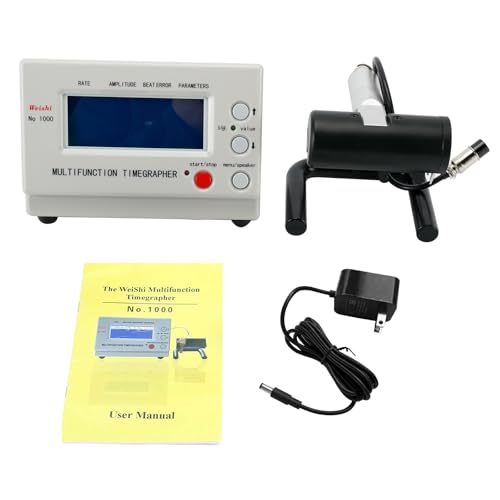
- Measures rate, amplitude, and beat error
- Six positions with adjustable sampling times
- LCD timing lines and automatic signal adjustment
Best For: Hobbyists wanting flexible mechanical-watch testing
Professional Diagnostics
MechanBINGOX Professional Timegrapher

- Real-time rate, amplitude, and beat-error readings
- Six-position mechanical-watch testing
- Supports 18,000–36,000 BPH movements
Best For: Hobbyists and watchmakers needing detailed diagnostics
Compact Workbench Option

- Tests almost all mechanical watches
- Works with coaxial watches
- Compact, corded design
Best For: Collectors needing a straightforward mechanical-watch tester
Large-Screen Analysis

- Displays five live timing measurements
- Larger screen than the No.1000
- Works with mechanical and coaxial watches
Best For: Hobbyists wanting expanded readings on a larger LCD
Compact Pocket-Watch Tester

- Designed for pocket watches
- Multifunction timegrapher format
- Verify size and model compatibility
Best For: Pocket-watch hobbyists checking compatibility before purchase
Large-Screen Coaxial Tester

- Larger LCD than the No.1000
- Supports mechanical and coaxial watches
- 100–240V power with regional plugs
Best For: Collectors wanting readable coaxial-watch testing
Precision Diagnostic Timegrapher

- Measures rate, amplitude, and beat error
- Tests six positions on mechanical watches
- Not compatible with quartz movements
Best For: Mechanical-watch enthusiasts needing detailed diagnostics
Best All-Around Pick
No.1000 Mechanical Watch Timegrapher
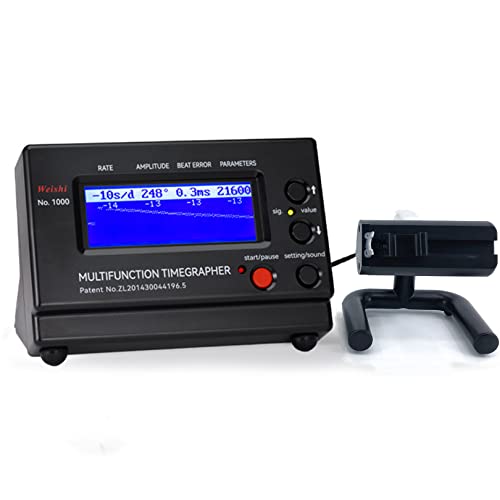
- Displays rate, amplitude, beat error, beat, and lift angle
- Easy to use for collectors and hobbyists
- Supports most mechanical and coaxial watches
Best For: Collectors and hobbyists seeking simple, broad mechanical-watch testing
Best Display Upgrade
No.1900 Multifunctional Watch Tester

- High-resolution color screen with two trace colors
- Measures key timing and amplitude metrics
- Supports one to six positions and coaxial watches
Best For: Users who want clearer visual diagnostics and flexible testing
Best Precision Features
Multifunctional No.1000 Watch Tester
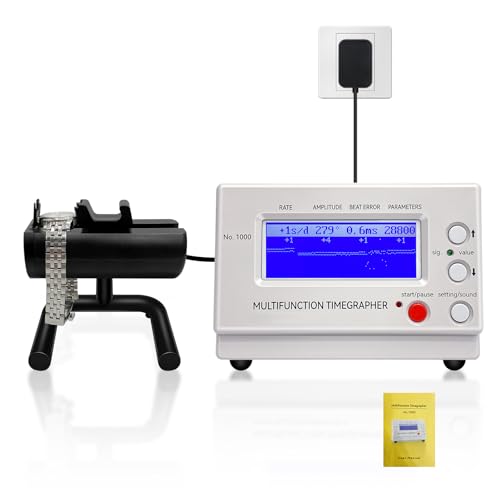
- Adds polarity and period testing to core readings
- Provides 0.1-second-per-day rate resolution
- Compact design with wide-voltage input
Best For: Experienced hobbyists and technicians performing detailed movement checks
Easy LCD Testing – YaeTek NO.1000 Timegrapher
For shoppers comparing watch timing machines for hobbyists, the YaeTek NO.1000 offers a straightforward way to check a mechanical watch’s rate, amplitude, and beat error. Its LCD displays live readings and moving timing lines, while automatic signal adjustment helps simplify setup.
Best For: Hobbyists and collectors who want adjustable testing periods and six-position analysis.
Pros:
- Measures rate, amplitude, and beat error automatically.
- Supports six testing positions and sampling periods from 2 to 60 seconds.
- LCD screen provides real-time readings and visual timing lines.
Cons:
- The supplied notes identify it for mechanical watch testing, not quartz watches.
- Its listed rate-deviation range is broad at ±999 seconds per day.
This is a practical entry-level-style option for users who value visible readings and flexible test durations. The 110V–220V US-plug specification should also suit many home workbench setups.
Professional Diagnostics – MechanBINGOX Professional Timegrapher
The MechanBINGOX timegrapher is aimed at shoppers seeking watch timing machines for hobbyists with more complete movement diagnostics. It displays rate, amplitude, beat error, and timing curves in real time, with six-position testing for comparing performance across orientations.
Best For: Collectors, hobbyists, and watchmakers evaluating automatic and mechanical movements.
Pros:
- Provides real-time rate, amplitude, beat-error, and timing-curve data.
- Tests dial-up, dial-down, and four crown positions.
- Supports common beat frequencies from 18,000 to 36,000 BPH.
- Uses a clear LCD for at-a-glance diagnostics.
Cons:
- It is not designed for quartz watches.
- The supplied information does not specify power requirements or physical dimensions.
With broad mechanical-watch compatibility and multi-position analysis, this model is a strong fit for users who want more than a basic rate check. Its feature set is suited to routine monitoring and movement regulation work.
Compact Workbench Option – NO.1000 Watch Timegrapher
Among watch timing machines for hobbyists, this compact NO.1000 focuses on core mechanical-watch timing tests. It uses a corded electric power source and a coaxial test design intended for almost all mechanical watches, making it suitable for collection monitoring and basic workshop use.
Best For: Collectors and hobbyists who want a compact, corded tester for mechanical watches.
Pros:
- Designed to test almost all mechanical watches, including coaxial models.
- Multi-purpose timegrapher format suits collection and watchmaker use.
- Compact listed dimensions fit smaller workspaces.
Cons:
- The supplied notes do not list amplitude or beat-error display features.
- It requires corded electric power with a minimum operating voltage of 100 volts.
This model keeps the feature description focused on essential timing measurement rather than extensive diagnostics. It may appeal to buyers prioritizing a compact footprint and straightforward mechanical-watch compatibility.
Large-Screen Analysis – No.1900 Watch Timegrapher
The No.1900 is a useful choice for shoppers comparing watch timing machines for hobbyists who want a larger display and expanded measurements. Its LCD shows live rate, amplitude, beat error, beat, and lift angle readings, and the unit is described as ready to use out of the box.
Best For: Hobbyists and collectors who want broad live readouts and coaxial-watch compatibility.
Pros:
- Displays rate, amplitude, beat error, beat, and lift angle.
- Features a larger screen than the No.1000 according to the supplied notes.
- Works with almost all mechanical watches, including coaxial watches.
- Includes a one-year warranty and customer-service support.
Cons:
- The supplied notes do not specify multi-position testing.
- It is intended for mechanical watches rather than quartz models.
For users who prefer a broader on-screen view, the No.1900 offers more displayed metrics than a basic timing tester. Its stated ease of use and warranty may also make it appealing for home hobbyist setups.
Compact Pocket-Watch Tester – Ewatchparts Timegrapher 1000
Ewatchparts Watch Timing Machine Multifunction Timegrapher 1000 Compatible With Pocket Watch
Check Price On AmazonFor shoppers comparing watch timing machines for hobbyists, this Ewatchparts multifunction timegrapher is positioned as a compact option for pocket watches. Because the supplied information emphasizes model and size compatibility, verify your watch measurements with a ruler before ordering.
Best For: Hobbyists who need a timing machine compatible with pocket watches and are prepared to confirm fit before purchase.
Pros:
- Designed to fit pocket watches.
- Multifunction timegrapher format.
- Compact 2-inch listed length.
Cons:
- Compatibility and sizing must be verified carefully.
- The supplied details do not specify supported quartz or mechanical movement types.
- It is an aftermarket/generic product rather than a stated original-brand part.
This can be a practical starting point for pocket-watch hobbyists, but its limited specifications make compatibility checking especially important before buying.
Large-Screen Coaxial Tester – MTG No.1900 Timegrapher
OTOOLWORLD New Coaxial MTG Watch Tester Timing Multifunction Timegrapher LCD Screen NO.1900
Check Price On AmazonAmong watch timing machines for hobbyists, the MTG No.1900 stands out for its larger LCD screen and stated compatibility with almost all mechanical watches, including coaxial watches. Its corded 100–240V power setup and exchangeable regional plugs add flexibility for different locations.
Best For: Hobbyists and collectors who want an easier-to-view digital timegrapher with coaxial-watch support.
Pros:
- Larger LCD screen than the No.1000 model.
- Works with almost all mechanical watches and is intended to work better with coaxial watches.
- Supports 100–240V power and includes exchangeable regional mini plugs.
Cons:
- Requires corded electric power.
- The supplied notes do not provide detailed accuracy, sampling, or measurement-range specifications.
- Regional plug fit may still need to be checked for your location.
The No.1900 is a sensible choice when screen readability and coaxial-watch compatibility matter more than portability or detailed published performance figures.
Precision Diagnostic Timegrapher – SWANSOFT No.1000 Timegrapher
For hobbyists seeking watch timing machines with broader diagnostic data, the SWANSOFT No.1000 provides rate, amplitude, beat error, lift angle, and timing curves on a color LCD. It is intended for mechanical movement watches only, not quartz watches, and supports testing across six positions.
Best For: Mechanical-watch enthusiasts, watchmakers, and collectors who want detailed timing analysis and adjustable testing options.
Pros:
- Claims ±0.1 seconds per day accuracy with a 50-sample average and a ±999 seconds-per-day range.
- Displays rate, amplitude, beat error, lift angle, and timing curves.
- Supports six positions, adjustable sampling cycles, and lift angles from 30° to 70°.
- Includes a 12-month satisfaction guarantee and stated support.
Cons:
- Not compatible with quartz movement watches.
- Its detailed functions may be more than casual users need.
- The unit weighs 1.27 kg, so it is better suited to a bench than mobile use.
This is the most specification-rich option in the group for mechanical-watch diagnostics, particularly if you want multiple measurements and position testing rather than basic timing checks.
Best All-Around Pick – No.1000 Mechanical Watch Timegrapher
KINSANINC Watch Tester Timegrapher No.1000, Watch Timing Machine Calabration for Mechanical Watches
Check Price On AmazonFor hobbyists comparing watch timing machines for hobbyists, the No.1000 is a straightforward choice for checking core mechanical-watch performance. Its digital display shows rate, amplitude, beat error, beat, and lift angle, and it automatically adjusts the signal level for different watches.
Best For: Watch collectors and hobbyists who want an easy-to-use tester for most mechanical and coaxial watches.
Pros:
- Displays rate, amplitude, beat error, beat, and lift angle.
- Ready to use out of the box with simple operation.
- Works with almost all mechanical watches, including coaxial models.
- Includes a one-year warranty and customer support.
Cons:
- Uses a monochrome-style digital display rather than a color screen.
- Designed for corded electric operation.
The No.1000 balances useful measurements and easy operation without adding unnecessary complexity. It is a sensible entry point for a hobbyist bench, while its coaxial-watch compatibility also gives it broader utility.
Best Display Upgrade – No.1900 Multifunctional Watch Tester
The No.1900 stands out among watch timing machines for hobbyists with its larger, high-resolution color display and separate yellow and light-blue traces. Those visual aids can make beat-error adjustment and entrance-versus-exit troubleshooting easier than with the No.1000.
Best For: Hobbyists, collectors, and watchmakers who want clearer diagnostics and multiple measuring positions.
Pros:
- Measures rate deviation, amplitude, beat error, beat number, and lift angle.
- Color screen shows two traces to help distinguish entrance and exit pings.
- Supports one to six measuring positions and mechanical or coaxial watches.
- Includes a sensor, US adapter, manual, and cleaning cloth.
Cons:
- Its added diagnostic features may be more than casual users need.
- The supplied notes identify it as an AC-powered unit rather than a portable battery model.
Choose the No.1900 when screen clarity and troubleshooting information matter more than keeping the setup basic. Its display and trace separation make it the more feature-focused option in this group, with an 18-month satisfaction guarantee noted by the manufacturer.
Best Precision Features – Multifunctional No.1000 Watch Tester
For hobbyists looking for watch timing machines for hobbyists with deeper measurement options, this multifunctional No.1000 adds polarity and period testing to the usual rate, amplitude, beat, and lift-angle readings. Its acoustic sensor, adjustable sampling period, and compact design suit a dedicated home workbench.
Best For: Enthusiasts and technicians who want detailed mechanical-movement checks in a compact machine.
Pros:
- Tests daily rate, beat amplitude, polarity, beat, lift angle, and period.
- Offers 0.1 seconds-per-day resolution and a rate range of ±999 seconds per day.
- Supports one to six directional measurements and a 100°–360° amplitude range.
- Works with 100V–240V input and has a lightweight, space-saving design.
Cons:
- Its more technical controls may require a learning period for beginners.
- It is not water resistant.
- The supplied notes specify a 365-day warranty.
This model is the strongest fit when measurement depth matters more than the simplest user experience. Manual beat selection, dense sampling, and polarity readings give experienced users more information for maintenance and diagnosis.
How We Picked the Best Watch Timing Machines for Hobbyists
We focused on the measurements that matter most when checking mechanical watches: rate, amplitude, beat error, beat rate, and lift-angle support. We also considered how clearly each unit presents readings, how simple it is to position a watch, and whether its controls are practical for repeated testing.
Because product listings can vary by seller and production batch, verify the included accessories, power requirements, microphone design, and return policy before buying. A timegrapher is a diagnostic instrument, so consistency and usable feedback matter more than decorative extras.
Quick Comparison
| Feature | Why It Matters | What to Look For |
|---|---|---|
| Core readings | Shows how the movement is performing | Rate, amplitude, beat error, and beat rate |
| Display | Makes adjustment work easier | Readable LCD, waveform, and numerical results |
| Position testing | Reveals variation between orientations | Stable holder and multiple test positions |
| Compatibility | Helps avoid misleading results | Mechanical-watch support and adjustable lift angle |
| Controls | Speeds up repeated measurements | Simple menus and easy parameter changes |
Key Buying Factors for Watch Timing Machines for Hobbyists
Measurement Accuracy and Consistency
Look for a tester that produces stable readings rather than numbers that fluctuate excessively. Accuracy claims should be treated cautiously, but repeatable results are valuable when comparing positions or checking whether a regulation made a difference.
Beat Rate and Lift-Angle Settings
Many mechanical watches use common beat rates, but vintage, unusual, and modified movements may differ. A wider beat-rate range and adjustable lift angle improve compatibility. The wrong lift-angle setting can make amplitude readings appear inaccurate even when the movement is healthy.
Readability and Operation
A clear screen, visible waveform, and straightforward controls reduce guesswork. If you plan to regulate watches, prioritize a unit that lets you quickly change beat rate, lift angle, and test duration without navigating complicated menus.
Holder, Microphone, and Power Setup
The watch must sit securely and transmit a clean ticking signal. Check whether the design accommodates wristwatches and pocket watches, and confirm whether it uses a built-in microphone, external sensor, USB power, or an included adapter.
Who Should Buy Which Watch Timing Machines for Hobbyists?
Choose a basic No.1000-style timegrapher if you want essential readings at a lower cost for occasional checks. It is generally suitable for beginners who are learning how rate and beat error respond to regulation.
A No.1900-style model is a better fit if you prefer a larger or more informative LCD presentation, additional controls, or a more workshop-oriented interface. These features can be worthwhile for enthusiasts testing several watches or comparing multiple positions.
Consider a model specifically described as compatible with pocket watches if you work on larger cases or older movements. For frequent servicing, prioritize stable mounting, broad parameter adjustment, clear readings, and dependable seller support over the lowest advertised price. Whichever unit you choose, use it as a diagnostic aid and confirm major service decisions with proper movement inspection.