
Last Updated on: October 29, 2026
A reliable watch timing machine makes it easier to evaluate a mechanical watch’s rate, amplitude, beat error, and beat frequency before and after adjustment.
This roundup compares 10 timegrapher-style testers, including compact No. 1000 models and larger LCD-equipped No. 1900 options, so you can match features and workflow to your bench.
Best 10 Watch Timing Machine Picks for 2026
Best All-Around Value
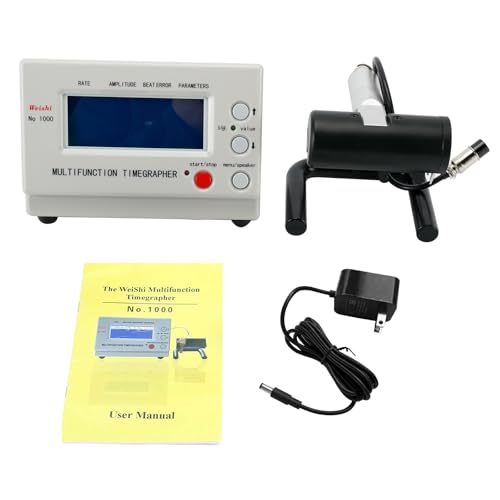
- Measures rate, amplitude, and beat error
- Six positions with adjustable sampling periods
- LCD display with live timing visualization
Best For: Mechanical-watch collectors and hobbyists
Best Professional Option
MechanBINGOX 6-Position Timegrapher

- Real-time rate, amplitude, and beat-error analysis
- Six-position testing for movement consistency
- Supports common mechanical-watch beat frequencies
Best For: Watchmakers, repair shops, and serious collectors
Best Compact Basic Tester
NO.1000 Multifunction Timegrapher

- Compact corded design
- Coaxial testing for mechanical watches
- Suitable for collections and workshop use
Best For: Users seeking simple mechanical-watch timing checks
Best for Coaxial Watches

- Compatible with mechanical and coaxial watches
- Larger LCD screen than the NO.1000
- 100V–240V power with exchangeable plugs
Best For: Users testing coaxial movements and preferring a larger display
Best Precision Pick
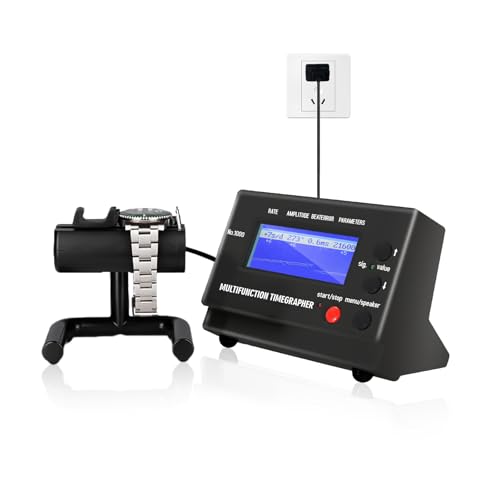
- Reported ±0.1 s/d accuracy from a 50-sample average
- Tests six positions with adjustable sampling cycles
- Measures rate, amplitude, beat error, and lift angle
Best For: Professional watchmakers and advanced mechanical-watch hobbyists
Best Large-Screen Option

- Upgraded larger, high-resolution color LCD
- Displays rate, amplitude, beat error, beat, and lift angle
- Includes sensor, US adapter, and user manual
Best For: Collectors and users who want easy-to-read mechanical-watch readings
Best Beginner Value

- Measures rate, beat rate, beat error, and amplitude
- Shows timing results graphically and numerically
- Includes automatic signal-level adjustment and an 18-month guarantee
Best For: Novice watchmakers learning mechanical-watch diagnostics
Best Overall Display
TICFROG No.1900 Watch Timegrapher

- High-resolution color screen
- Separates entrance and exit traces
- Measures rate, amplitude, and beat error
Best For: Watchmakers and collectors who want clearer diagnostics
Best Technical Value
No.1000 Multifunctional Watch Tester
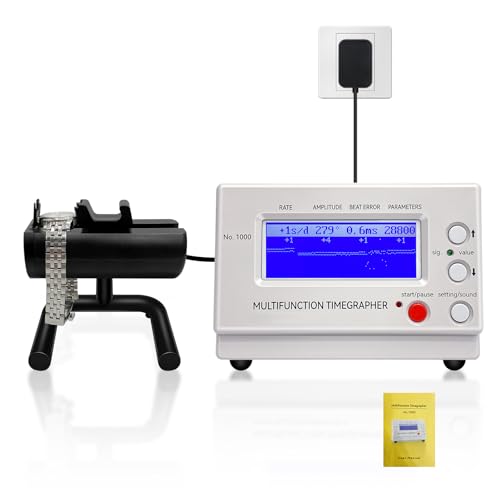
- Tests seven key movement metrics
- Supports adjustable sampling periods
- Compact with wide-voltage input
Best For: Technicians and advanced mechanical-watch enthusiasts
Best for Beginners
TICFROG No.1000 Watch Timegrapher

- Measures rate, beat error, and amplitude
- Shows readings graphically and numerically
- Includes sensor and setup accessories
Best For: Novice watchmakers and basic accuracy checks
Best All-Around Value – YaeTek NO.1000 Timegrapher
This watch timing machine is a practical choice for mechanical-watch owners who want automated rate, amplitude, and beat-error readings without a complicated setup. Its LCD display, adjustable testing positions, and selectable sampling periods make it useful for routine collection checks.
Best For: Mechanical-watch collectors and hobbyists seeking a versatile, easy-to-use tester.
Pros:
- Automatically calculates rate, amplitude, and beat error.
- Offers six adjustable testing positions.
- Displays live readings and visual timing curves on the LCD screen.
- Supports sampling periods from 2 to 60 seconds.
Cons:
- Designed for mechanical watches rather than quartz models.
- Uses a corded 110V–220V US-plug setup.
With broad adjustment options and clear real-time feedback, the YaeTek NO.1000 is a well-rounded watch timing machine for basic diagnosis and monitoring.
Best Professional Option – MechanBINGOX 6-Position Timegrapher
This professional watch timing machine focuses on movement diagnostics, showing rate, amplitude, beat error, and timing curves in real time. Its six-position testing and support for common beat frequencies make it suited to more thorough mechanical-watch evaluations.
Best For: Watchmakers, repair shops, and collectors performing detailed mechanical-watch checks.
Pros:
- Provides real-time rate, amplitude, beat-error, and curve readings.
- Tests dial-up, dial-down, and four crown orientations.
- Supports 18,000, 21,600, 28,800, and 36,000 BPH.
- Clear LCD screen simplifies reading diagnostic data.
Cons:
- Not designed for quartz watches.
- Its professional feature set may be more than casual users need.
The MechanBINGOX stands out when orientation consistency and movement-health analysis matter more than basic spot checks.
Best Compact Basic Tester – NO.1000 Multifunction Timegrapher
This compact watch timing machine offers a straightforward way to check mechanical-watch timing. The corded NO.1000 uses coaxial testing and a modern, compact housing, making it a practical option for collections and basic workshop use.
Best For: Mechanical-watch owners who want a simple, compact timing tester.
Pros:
- Compatible with almost all mechanical watches.
- Uses coaxial testing for timing measurement.
- Compact dimensions suit limited workspaces.
- Popular with professional watchmakers and collectors.
Cons:
- Supplied notes provide fewer display and adjustment details than some alternatives.
- Requires corded operation with a minimum operating voltage of 100 volts.
If you prioritize a small footprint and core mechanical-watch timing functionality, this NO.1000 is a focused, uncomplicated choice.
Best for Coaxial Watches – NO.1900 LCD Timegrapher
OTOOLWORLD New Coaxial MTG Watch Tester Timing Multifunction Timegrapher LCD Screen NO.1900
Check Price On AmazonThis watch timing machine is built around a larger LCD screen and coaxial-watch compatibility. Compared with the NO.1000, its bigger display is intended to provide a clearer view and easier operation while testing mechanical and coaxial watches.
Best For: Mechanical-watch users, especially those testing coaxial movements and wanting a larger display.
Pros:
- Works with mechanical and coaxial watches.
- Larger LCD screen than the NO.1000.
- Designed for easier viewing and operation.
- Includes 100V–240V power compatibility with exchangeable regional plugs.
Cons:
- The supplied notes do not specify detailed measurement ranges or testing positions.
- Regional plug compatibility depends on the appropriate included plug.
The NO.1900 is the stronger fit when display visibility and coaxial-watch testing are central requirements.
Best Precision Pick – SWANSOFT No.1000 Timegrapher
For watchmakers who need detailed movement diagnostics, the SWANSOFT No.1000 is a watch timing machine with reported ±0.1 seconds-per-day accuracy from a 50-sample average. It measures rate, amplitude, beat error, and other timing data for mechanical watches, while its color LCD displays live readings and timing curves.
Best For: Professional watchmakers, technicians, and advanced hobbyists servicing mechanical movements.
Pros:
- Supports six testing positions and 2–60-second sampling cycles.
- Displays rate, amplitude, beat error, lift angle, and timing curves.
- Offers an amplitude range of 100°–360° and adjustable lift angles from 30°–70°.
- Includes a sensor, US adapter, manual, and 12-month support.
Cons:
- Designed only for mechanical movements; it does not support quartz watches.
- Its broad professional feature set may be more than beginners need.
The No.1000 stands out when measurement detail and flexible testing matter. It is a strong bench instrument for diagnosing timing problems, though quartz-watch owners will need a different tester.
Best Large-Screen Option – SWANSOFT No.1900 Timegrapher
The SWANSOFT No.1900 is a watch timing machine focused on easy-to-read operation. Its upgraded, larger high-resolution color LCD presents live rate, amplitude, beat error, beat, and lift-angle readings, making it useful for evaluating how a mechanical watch is running.
Best For: Watch collectors, hobbyists, and technicians who prefer a larger backlit display.
Pros:
- Uses a larger, high-resolution color screen than the No.1000.
- Shows live timing measurements in an intuitive interface.
- Includes a timegrapher sensor, US adapter, and professional user manual.
- Suitable for hobbyists, collectors, and professional users.
Cons:
- Only supports mechanical movement watches, not quartz movements.
- The supplied notes do not specify accuracy, sampling options, or position-testing range.
Choose the No.1900 if screen visibility and straightforward readouts are priorities. It provides the core information needed for mechanical-watch timing checks without claiming the more detailed specifications listed for the No.1000.
Best Beginner Value – TICFROG No.1000 Timegrapher
The TICFROG No.1000 is a practical watch timing machine for learning the fundamentals of mechanical-watch regulation. It uses a sensor to detect escapement sounds or vibrations and displays beat rate, beat error, and amplitude both numerically and graphically.
Best For: Beginners and novice watchmakers who want essential timing data without an overly complex feature set.
Pros:
- Measures beat rate, beat error, amplitude, and watch rate.
- Presents results graphically and numerically for easier interpretation.
- Includes automatic signal-level adjustment.
- Comes with a sensor, US adapter, manual, and watch-cleaning cloth.
Cons:
- The product is intended for mechanical watches and does not list quartz support.
- The supplied notes provide fewer advanced specifications than the SWANSOFT models.
For a first watch timing machine, the TICFROG No.1000 covers the core measurements needed to identify whether a mechanical watch is gaining or losing time. Its 18-month satisfaction guarantee adds useful support for new users.
Best Overall Display – TICFROG No.1900 Watch Timegrapher
The TICFROG No.1900 is a watch timing machine for users who want a clearer view of mechanical-watch performance. Its high-resolution color screen separates entrance and exit traces, helping with beat-error adjustment and troubleshooting.
Best For: Watchmakers, collectors, and hobbyists who want expanded visual diagnostics and support for multiple measuring positions.
Pros:
- Color display shows separate yellow and light-blue traces for easier diagnosis.
- Measures rate deviation, amplitude, and beat error while displaying beat number and lift angle.
- Supports one to six measuring positions and 100V–240V AC power.
- Includes a sensor, US adapter, manual, and cleaning cloth.
Cons:
- Its advanced display may be more than beginners need.
- Designed for mechanical and coaxial watches rather than general electronic-watch testing.
Choose this model if trace visibility matters during calibration and fault diagnosis. It offers a more informative interface than the No.1000 while retaining straightforward operation and broad power compatibility.
Best Technical Value – No.1000 Multifunctional Watch Tester
This No.1000 watch timing machine covers the core measurements needed to evaluate mechanical-watch movements, including daily rate, amplitude, beat error, polarity, beat, lift angle, and period. It combines acoustic sensing with a compact design for workbench or portable use.
Best For: Technicians, makers, and serious enthusiasts who need broad measurement capability and adjustable sampling for mechanical-watch diagnosis.
Pros:
- Measures daily rate, amplitude, polarity, beat, lift angle, and period.
- Supports automatic standard-beat detection and manual special-beat selection.
- Offers two- to 60-second sampling periods and one to six directional measurements.
- Compact, lightweight body with a 100V–240V ±10% input range.
Cons:
- The 192×64-pixel display is less detailed than a larger high-resolution color screen.
- Its technical feature set may require time with the instructions for new users.
This model is a practical choice when measurement breadth is more important than display refinement. The stable sensor base, wide voltage input, and multiple testing controls make it suited to regular calibration work.
Best for Beginners – TICFROG No.1000 Watch Timegrapher
The TICFROG No.1000 is a straightforward watch timing machine for learning the basics of mechanical-watch accuracy. It measures beat rate, beat error, and balance-wheel amplitude, presenting results numerically and graphically for easier interpretation.
Best For: Novice watchmakers, collectors, and hobbyists performing basic accuracy checks on mechanical watches.
Pros:
- Focuses on the essential measurements needed to assess timekeeping.
- Displays rate, beat error, and amplitude in both graphical and numerical formats.
- Includes the timegrapher, sensor, US adapter, manual, and cleaning cloth.
- Compact design is suitable for a watchmaker’s bench.
Cons:
- Does not provide the expanded trace visibility of the No.1900 model.
- Requires users to consult the manual before operating advanced functions.
- Its plastic case and crystal are less substantial than metal-and-glass constructions.
For first-time users, this version keeps the core timegrapher workflow approachable without omitting the measurements needed for routine checks. It is a sensible starting point before moving to more advanced diagnostic equipment.
How We Picked the Best Watch Timing Machine Options
We focused on the measurements that matter during mechanical-watch diagnosis: rate deviation, amplitude, beat error, beat frequency, lift-angle support, and clear waveform or timing graphs. We also considered practical factors such as display readability, microphone or holder design, operating simplicity, portability, and suitability for occasional owners versus working watchmakers.
Because many timegraphers share similar specifications, the best choice often depends on consistency and workflow rather than headline features alone. A useful tester should hold the watch securely, detect the movement reliably, and present results that are easy to interpret while regulating.
Quick Comparison: Timegrapher Features
| Type | Best For | Typical Advantage | Potential Limitation |
|---|---|---|---|
| No. 1000-style tester | Home users and basic servicing | Compact, straightforward operation | Usually a simpler display and control layout |
| No. 1900-style tester | Frequent testing and professional benches | Larger LCD screen and more visible timing data | Often larger and more expensive |
| Multifunction timegrapher | Diagnostics and regulation | Combines several movement measurements | Requires correct setup and interpretation |
Key Buying Factors for a Watch Timing Machine
Measurements and Accuracy
Prioritize rate, amplitude, beat error, and beat frequency readings. Lift-angle adjustment is particularly useful because incorrect settings can make amplitude results misleading. A tester is a diagnostic aid, not a substitute for proper servicing or positional testing.
Display and Controls
Choose a clear LCD and uncomplicated controls if you will use the machine frequently. A readable graph can help reveal unstable regulation, inconsistent amplitude, or poor beat detection more quickly than numbers alone.
Watch Support and Sound Detection
Check whether the holder accommodates your case sizes and whether the microphone detects quiet or highly shielded movements consistently. Secure positioning matters: vibration, a loose crown, or an unsuitable lift-angle setting can affect the results.
Build, Power, and Workspace
Compact models suit small benches and occasional checks, while larger units may be easier to read during repeated adjustments. Confirm the included power arrangement and allow enough room to place the watch without touching the case or holder during testing.
Who Should Buy Which Watch Timing Machine?
Choose a No. 1000-style Watch Timing Machine if you want an accessible tool for learning, collecting, or occasional regulation checks. It is generally the sensible starting point when footprint and price matter most.
Choose a No. 1900-style model if you work on watches regularly and value a larger screen, faster visual feedback, or a more bench-oriented setup. Professional users should also consider repeatability, holder stability, and whether the interface supports an efficient adjustment-and-retest routine.
Whichever model you choose, compare readings in multiple positions and let the movement settle before making conclusions. Use the machine to identify patterns, then confirm that any adjustment improves performance across the positions relevant to the watch.