
Last Updated on: November 14, 2026
Reliable water-resistance testing helps small watch workshops reduce callbacks, protect customer timepieces, and verify repairs with greater confidence. The right tester depends on your workload, preferred testing method, pressure range, and available bench space.
We compared these 10 watch pressure testers for their testing capacity, controls, construction, readability, and suitability for routine workshop use.
Best 10 Watch Pressure Testers for Small Workshops Picks for 2026
Dual-Test Professional

- Tests two watches simultaneously
- 0.3–6.0 bar air-pressure range
- Clear chamber and sturdy aluminum construction
Best For: Small workshops prioritizing testing efficiency
Compact Workflow Pick
Two-Watch Water Resistance Tester

- Tests two watches at once
- 0.3–6.0 bar testing range
- Compact alloy design with transparent cylinder
Best For: Routine testing in space-conscious repair shops
Manual Leak Detection
Transparent-Cylinder Watch Tester
- 0.3–6.0 bar air-pressure range
- Bubble detection through a clear chamber
- No assembly; suitable for quartz and mechanical watches
Best For: Visual, hands-on leak checks in home or repair shops
Stable Two-Watch Workhorse
Watch Waterproof Testing Machine
- Tests two watches simultaneously
- 0.3–6.0 bar professional air testing
- Stable base with clear chamber and gauge
Best For: Repeated sealing checks in repair shops and manufacturing workflows
Best All-Around Manual Pick
0.3-6 Bar Glass-Cylinder Tester
- 0.3-6.0 bar gauge supports quartz and mechanical watches
- Transparent cylinder helps reveal air bubbles
- Manual pump and exhaust valve offer controlled testing
Best For: Small repair shops and serious watch enthusiasts
Best Electric Workflow
Dual-Watch Vacuum Pressure Tester

- Electric vacuum pressure operation reduces manual effort
- Designed to test two watches simultaneously
- Transparent tank makes observation easier
Best For: Small workshops focused on faster testing
Best Budget Manual Design
Dual-Watch Analog Pressure Tool
- Glass and aluminum alloy construction
- Transparent cylinder and large analog dial
- Designed for simultaneous testing of two watches
Best For: Routine manual testing in compact repair workshops
Dual-Watch Workshop Tester
Transparent Case Resistance Tool
- Tests two watches simultaneously
- Transparent cylinder and large pressure dial
- Fits watches up to 2.6 inches wide
Best For: Small repair benches needing efficient routine testing
Compact Shop Tester
10 Bar Watch Waterproof Test Tool

- Compact footprint for small workspaces
- Tests two watches simultaneously
- Designed for home and repair-shop use
Best For: Space-conscious watch repair counters
Visual Pressure Tester
Dual-Watch Water Resistance Machine

- Clear cylinder for visible leak inspection
- Oversized gauge for pressure monitoring
- Tests two watches at once
Best For: Benches prioritizing visibility during case testing
Dual-Test Professional – 10-Bar Watch Pressure Tester
For small workshops looking for watch pressure testers, this model combines a transparent chamber, clear pressure dial, and dual-watch testing. Its 0.3–6.0 bar air-pressure range and 10 bar maximum cylinder pressure support checks across everyday, swimming, and diving-waterproofing conditions.
Best For: Small repair shops that want to test two compatible watches at once while keeping equipment compact.
Pros:
- Tests two watches simultaneously to help improve workflow.
- Transparent glass cylinder and large dial support clear visual monitoring.
- Sturdy aluminum-and-glass construction, non-slip feet, and ergonomic rubber handle.
- Arrives assembled and supports watches up to 2.6 inches in diameter and 2.8 inches in height.
Cons:
- Its 7.5-pound weight may be more than needed for highly portable setups.
- Compatibility is limited by the stated chamber dimensions.
This is a practical choice when throughput matters. The dual-watch format and stable construction suit repeated workshop use, while the manual design keeps operation approachable for beginners and experienced watchmakers.
Compact Workflow Pick – Two-Watch Water Resistance Tester
Advanced Watch Water Tool for Reliable Water Resistance Testing of Two Watches Simultaneously
Check Price On AmazonAmong watch pressure testers for small workshops, this compact two-watch tool focuses on straightforward operation and visible leak diagnosis. The 0.3–6.0 bar testing range helps workshops evaluate sealing performance while keeping the process easy to observe.
Best For: Amateurs and watch repair businesses needing a compact tester for routine two-watch assessments.
Pros:
- Tests two watches simultaneously for a more efficient workflow.
- Transparent cylinder makes leaks easier to identify during testing.
- Compact design is suited to storage in a smaller workshop.
- Alloy construction is intended to withstand regular daily use.
Cons:
- The supplied notes do not specify a maximum cylinder pressure.
- Its listed dimensions may limit compatibility with larger watch cases.
This model emphasizes accessibility and space savings rather than extensive specifications. It can make sense for a small repair bench where clear leak visibility and simultaneous testing are more important than advanced controls.
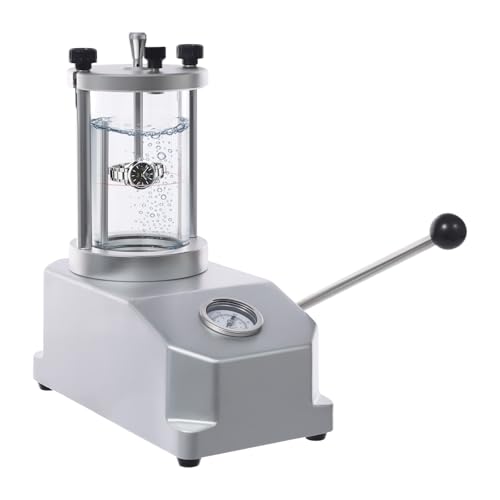
Manual Leak Detection – Transparent-Cylinder Watch Tester
This watch pressure tester is designed for small workshops that want a direct, visual way to check watch-case sealing. Its transparent cylinder, bubble-based leak detection, and 0.3–6.0 bar air-pressure range support testing of both quartz and mechanical watches.
Best For: Home users and repair shops seeking an immediately usable manual tester with clear bubble detection.
Pros:
- Transparent chamber allows visual monitoring throughout the test.
- Simple shake-lever system and exhaust button require no assembly.
- Works with quartz and mechanical watches.
- Aluminum, glass, and rubber construction includes anti-slip feet and rounded edges.
Cons:
- Manual operation may require more hands-on effort than automated equipment.
- Testing space is limited to cases up to 6.5 cm in diameter, as stated in the product title.
- The unit weighs 3.4 kg, so it is not especially lightweight.
Its strongest advantage is clarity: operators can watch for bubbles while controlling pressure manually. The included 360-day warranty adds useful support for a compact workshop tool.
Stable Two-Watch Workhorse – Watch Waterproof Testing Machine
For small workshops that value repeatable handling, this watch pressure tester pairs a transparent chamber with a large pressure gauge and stable rubber-footed base. It operates from 0.3–6.0 bar and can test two watches simultaneously, helping streamline routine sealing checks.
Best For: Repair shops and manufacturers needing a durable dual-watch tester for compatible quartz and mechanical watches.
Pros:
- Simultaneous testing of two watches can improve workshop throughput.
- Transparent chamber and large gauge support real-time observation and pressure control.
- Durable glass, aluminum alloy, and rubber construction is designed for repeated use.
- Accommodates watches up to 2.6 inches in diameter and 2.8 inches in height.
Cons:
- No warranty is listed in the supplied details.
- The stated case-size limits may exclude larger watches.
- Its professional construction may be more equipment than occasional users need.
This is a strong fit for a bench that regularly handles waterproofness evaluations. Its dual capacity, stable base, and readable gauge make it oriented toward efficient repeated use, provided the watches fall within the chamber limits.
Best All-Around Manual Pick – 0.3-6 Bar Glass-Cylinder Tester
For small workshops wanting watch pressure testers for small workshops with broad compatibility, this manual model combines a 0.3-6.0 bar gauge with a transparent glass cylinder. It supports visual bubble inspection and accommodates many quartz and mechanical watches.
Best For: Watch repair shops, serious hobbyists, and users who want controlled manual testing.
Pros:
- Wide 0.3-6.0 bar gauge range for quartz and mechanical watches
- Transparent cylinder makes air bubbles and leaks easier to observe
- Aluminum alloy frame, rubber seals, and generous 2.6-inch diameter capacity
- Manual pump and exhaust valve provide controlled pressure application and release
Cons:
- Manual operation is less convenient than an electric tester
- Its 8.82-pound, 9.5-by-5.5-by-10.6-inch design may require dedicated bench space
This is a practical, ready-to-use choice when visual inspection and pressure control matter more than automated operation or compactness.
Best Electric Workflow – Dual-Watch Vacuum Pressure Tester
Among watch pressure testers for small workshops, this electric model stands out for faster, less manual operation. Its vacuum pressure system is designed to test two watches simultaneously, while the transparent tank allows visual monitoring during the process.
Best For: Workshops prioritizing throughput and electric operation.
Pros:
- Electric vacuum pressure system reduces manual effort
- Designed for simultaneous testing of two watches
- Transparent tank supports easy observation during testing
- Includes a power supply for immediate setup
Cons:
- Requires access to electrical power
- The supplied notes do not specify the pressure range or watch-size capacity
Choose this tester when dual-watch capacity and convenience are more important than having a documented manual pressure range or a fully portable setup.
Best Budget Manual Design – Dual-Watch Analog Pressure Tool
This manual option gives small workshops a straightforward way to evaluate watch case resistance. It uses a glass-and-aluminum construction, a transparent cylinder, and an analog pressure dial, with capacity for two watches at once according to the supplied specifications.
Best For: Watchmakers seeking simple visual testing and dual-watch capacity.
Pros:
- Glass and aluminum alloy construction is designed for durability
- Transparent cylinder and large dial support visual monitoring
- Can test two watches simultaneously
- Fits watches up to 2.6 inches in diameter and 2.8 inches in height
Cons:
- The listed 0.3-0.6 bar range is narrower than some competing manual testers
- Manual operation requires more hands-on effort
Its ergonomic handle and dual-watch format make it appealing for routine bench work, though the limited stated pressure range may not suit every testing requirement.
Dual-Watch Workshop Tester – Transparent Case Resistance Tool
For small workshops comparing watch pressure testers, this model combines dual-watch testing with a transparent cylinder and an easy-to-read pressure dial. Its compact footprint and aluminum-and-glass construction make it a practical option for routine mechanical and quartz watch checks.
Best For: Small repair benches that need to test two watches at once.
Pros:
- Tests two watches simultaneously to improve workflow.
- Transparent glass cylinder helps with visual inspection.
- Supports watches up to 2.6 inches in diameter and 2.8 inches in height.
- Soft rubber handle and long handle design support comfortable operation.
Cons:
- The stated air-pressure range is limited to 0.3–0.6 bar.
- At 8.8 pounds, it is not especially lightweight for portable use.
This is a straightforward choice when visibility, dual-watch capacity, and broad compatibility matter more than portability or a wider pressure range.
Compact Shop Tester – 10 Bar Watch Waterproof Test Tool
Among watch pressure testers for small workshops, this compact unit is designed for home use, watch shops, and repair shops. It supports two-watch testing, offers a transparent viewing cylinder, and can be stored in a relatively small workspace.
Best For: Space-conscious workshops and repair counters handling mechanical and quartz watches.
Pros:
- Compact 9.5 × 5.5 × 10.6-inch design fits small storage areas.
- Tests two watches at the same time.
- Transparent cylinder and large dial make monitoring easier.
- Accommodates watches up to 2.6 inches in diameter and 2.8 inches in height.
Cons:
- The listed air-pressure testing range is 0.3–0.6 bar despite the 10 bar product description.
- Its 8.8-pound weight may limit easy transport.
Choose this version if bench space is a priority and you want a dual-watch tester with clear visual monitoring for common watch sizes.
Visual Pressure Tester – Dual-Watch Water Resistance Machine
This dual-watch pressure tester suits small workshops that want direct visual monitoring during case-resistance checks. The aluminum-and-glass build, compact dimensions, and oversized gauge provide a practical setup for testing many mechanical and quartz watches.
Best For: Workshops prioritizing clear pressure readings and visible leak inspection.
Pros:
- Supports simultaneous testing of two watches.
- Transparent cylinder helps identify potential case leaks.
- Oversized pressure gauge supports real-time monitoring and adjustment.
- Fits watches up to 2.6 inches in diameter and 2.8 inches in height.
Cons:
- The supplied notes state a 0.3–0.6 bar air-pressure range, so the broader range implied by the title should be verified.
- Its 9.5 × 5.5 × 10.6-inch body still requires dedicated bench or storage space.
This model is a sensible fit when your workflow benefits from an oversized gauge and unobstructed viewing, provided its actual pressure specifications match your testing needs.
How We Picked the Best Watch Pressure Testers for Small Workshops
We focused on practical workshop requirements rather than headline features alone. The comparison considers pressure range, whether the unit supports air, vacuum, water, or combined testing, and whether it can test one or two watches at once. We also looked at enclosure visibility, gauge readability, operating method, construction materials, footprint, and the likelihood that a small repair bench can use and maintain the tool comfortably.
These testers are intended to help identify potential leaks and verify water-resistance performance after servicing. They should be used according to the manufacturer’s instructions and with appropriate follow-up procedures when a test indicates a problem.
Quick Comparison
| Tester type | Best for | Main advantage | Watch capacity |
|---|---|---|---|
| Manual pressure tester | Routine bench testing | Simple operation and low maintenance | One or two, depending on design |
| Transparent-cylinder tester | Visual leak checks | Easy observation during testing | Usually one |
| Dual-watch tester | Higher service throughput | Tests two cases in one cycle | Two |
| Electric vacuum or pressure tester | Repeatable shop workflows | Less manual pumping | One or two, depending on model |
| Adjustable air-pressure tester | Mixed watch collections | Flexible pressure selection | Usually one or two |
Key Buying Factors for Watch Pressure Testers for Small Workshops
Pressure Range and Testing Method
Choose a range that matches the water-resistance ratings you commonly service. A 6-bar or 10-bar model can suit many everyday repairs, while adjustable systems offer more flexibility. Confirm whether the tester uses air pressure, vacuum, water, or a combination; the method affects both workflow and the type of diagnosis possible.
Capacity and Workflow
Dual-watch models can improve productivity when you regularly process multiple repairs, but they may take up more space and require more careful loading. A compact single-watch tool can be the better choice for occasional testing or a crowded bench.
Visibility, Gauge Quality, and Controls
A clear cylinder or window makes it easier to observe bubbles or other signs of leakage. Look for an easy-to-read gauge, positive controls, stable seals, and a mechanism that does not feel difficult to operate repeatedly.
Build and Maintenance
Aluminum-alloy or similarly durable housings can withstand regular workshop use, while robust seals and fittings are essential for reliable readings. Check replacement-seal availability, cleaning requirements, and whether the unit can be serviced locally.
Who Should Buy Which Watch Pressure Testers for Small Workshops?
Choose a manual tester if you want straightforward operation, minimal electronics, and a cost-conscious addition to a small repair bench. Choose a transparent-cylinder model if visual inspection is central to your leak-detection process. Choose a dual-watch tester if your workshop values faster batch testing and has enough bench space.
Choose an electric model when repeatability and reduced manual effort matter more than the simplest possible setup. If you service watches with varied ratings, prioritize adjustable pressure and a clearly marked gauge. In every case, verify the stated range, included fittings, vessel capacity, and operating instructions before purchase.